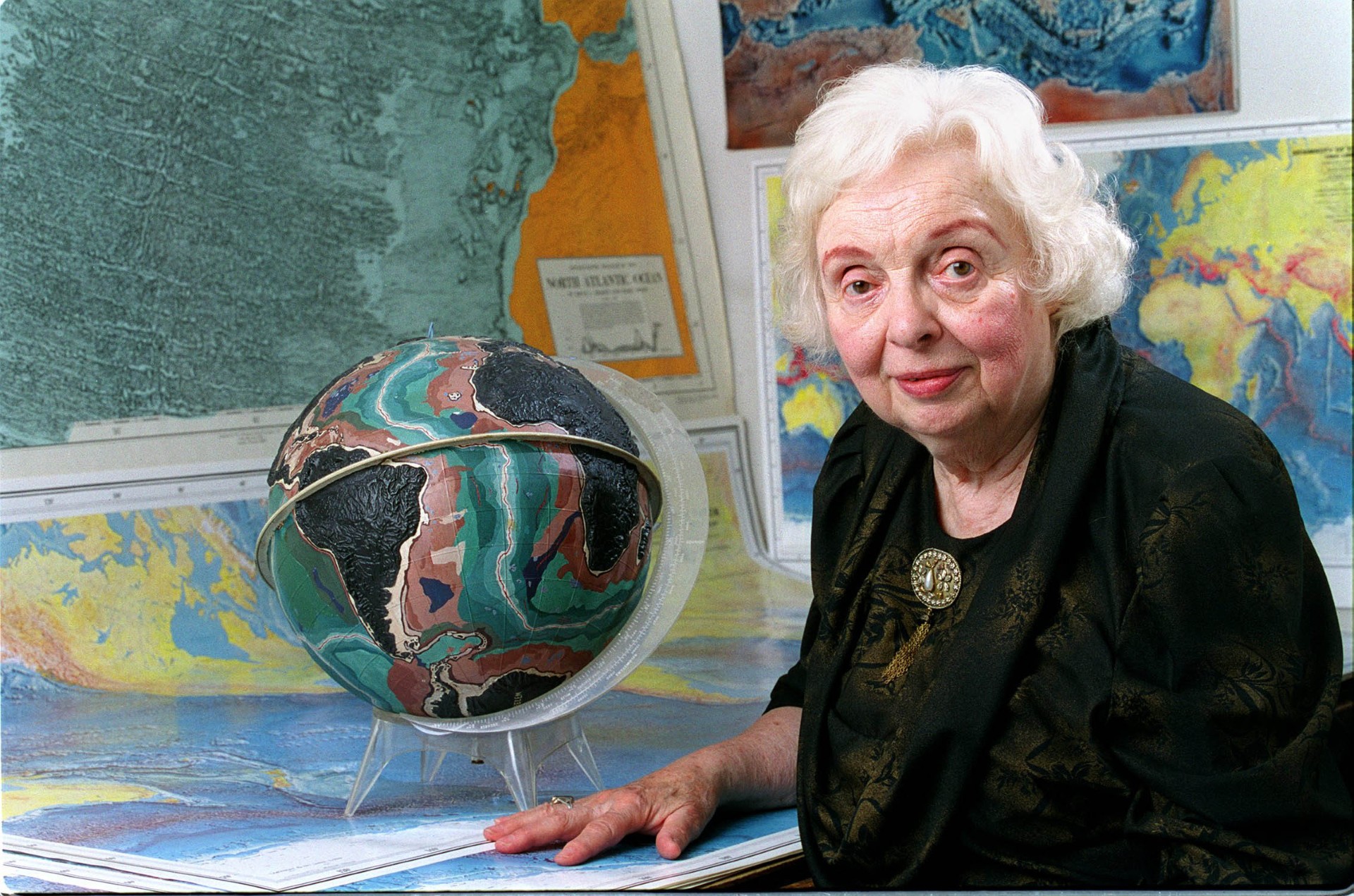
In 1948, when Marie Tharp began working at the Lamont Geological Laboratory (now the Lamont-Doherty Earth Observatory at Columbia University), the seafloor was believed to be mostly flat and featureless.
When Tharp and her colleague Bruce Heezen published the first map of the Atlantic in 1957, her painstaking hand-drawn work revealed a seafloor shaped by canyons, ridges, and mountains. Over time, she uncovered the mid-ocean ridge system—a continuous chain of undersea mountains stretching more than 40,000 miles around the globe.
In 1977, Tharp and Heezen published the first complete world map of the ocean floors. Their work helped confirm plate tectonics—the once-controversial theory that continents move over time. The discovery revolutionized our understanding of how nearly everything on the planet works.
Tharp began her career at a time when few women worked as scientists. Barred from the ships collecting seafloor data, she didn’t set foot on a research cruise until 1968. When she first identified evidence of seafloor spreading, it was dismissed as ‘girl talk.’
Today, Marie Tharp is recognized as the groundbreaking geologist and oceanographic cartographer she was. In 1997, the Library of Congress named her one of the four greatest cartographers of the 20th century. She died in 2006 at the age of 86, but her legacy endures—in the science she reshaped and the generations of women she inspired.